

The 2026 MLS season is here! In a three-part special, we will preview the upcoming Portland Timbers season and give you all of the storylines to follow and knowledge you need to impress your friends with as another great footy crusade begins.
This is Part Two of the season preview. You can read Part One here. Be on the lookout for Part Three coming at the end of the week!
Sometimes a title for a season comes after it is nearly over. For example, the Portland Timbers 2018 season is probably best known as "Dairon Asprilla and the Seattle Car Show" (IYKYK). Portland's 2021 could be called "Diego Valeri's Last Ride", although we didn't know that until after it was done.
But sometimes, the title for a season comes like a shining beacon, descending from the heavens before the first ball is even kicked. In the case of 2026, that beacon is American Soccer Analysis and the heavens are advanced analytics.
And the title is: "Phil Neville & The Dribbly Boys".
Preview time: @mattbarger.bsky.social talks about the dribbly bois in Portland, @beninquiring.bsky.social is a Bradley believer, and @philwest.bsky.social speaks the gospel according to Moose www.americansocceranalysis.com/home/2026/2/...
— American Soccer Analysis (@americansocceranalysis.com) 2026-02-13T17:16:12.019Z
Before you go any further, please go read American Soccer Analysis' excellent preview of the Portland Timbers season. Matt Barger does an awesome job diving into the numbers behind Portland's attack, and particularly their midfield. I'm going to be using that preview as a baseline for everything that I'm going to say next, so it really is essential reading.
As for what I am going to talk about, this will be my best guess at prognosticating how Portland will want to try to play tactically this season, what their anticipated strengths and weaknesses will be, and how effective (or ineffective) I think it's all going to be.
So seriously, go read Matt's piece! Last chance!
All done? Cool – let's dive in.
What do we know?
Let's start with the easiest part: we know that Phil Neville is a strong 4-2-3-1 adherent. According to what's left of FBref, the Timbers lined up in a standard 4-2-3-1 21 times last season, with a further three times in what was listed as a 4-4-2 but probably looked more like a 4-2-3-1.
So that's 24 total – the majority of competitive fixtures from 2025. Neville will sometimes toggle to a back three (usually a 3-4-3 variation), but his preference is definitely for the ol' 4-2-3-1.
However, the current state of the roster may push Neville towards using the 4-2-3-1's aggressive and reckless cousin, the 4-3-3. Portland's current midfield is constructed where, in order to maximize its strength, it is very likely that they will play a single-pivot rather than a double-pivot.
I know we don't necessarily know that, but I think we can reasonably confident in Portland playing with one pure defensive midfielder rather than two. Therefore, we can put together the current ideal starting XI would look for Portland. (Note that this is when everyone is healthy, so this is not what opening night will look like):
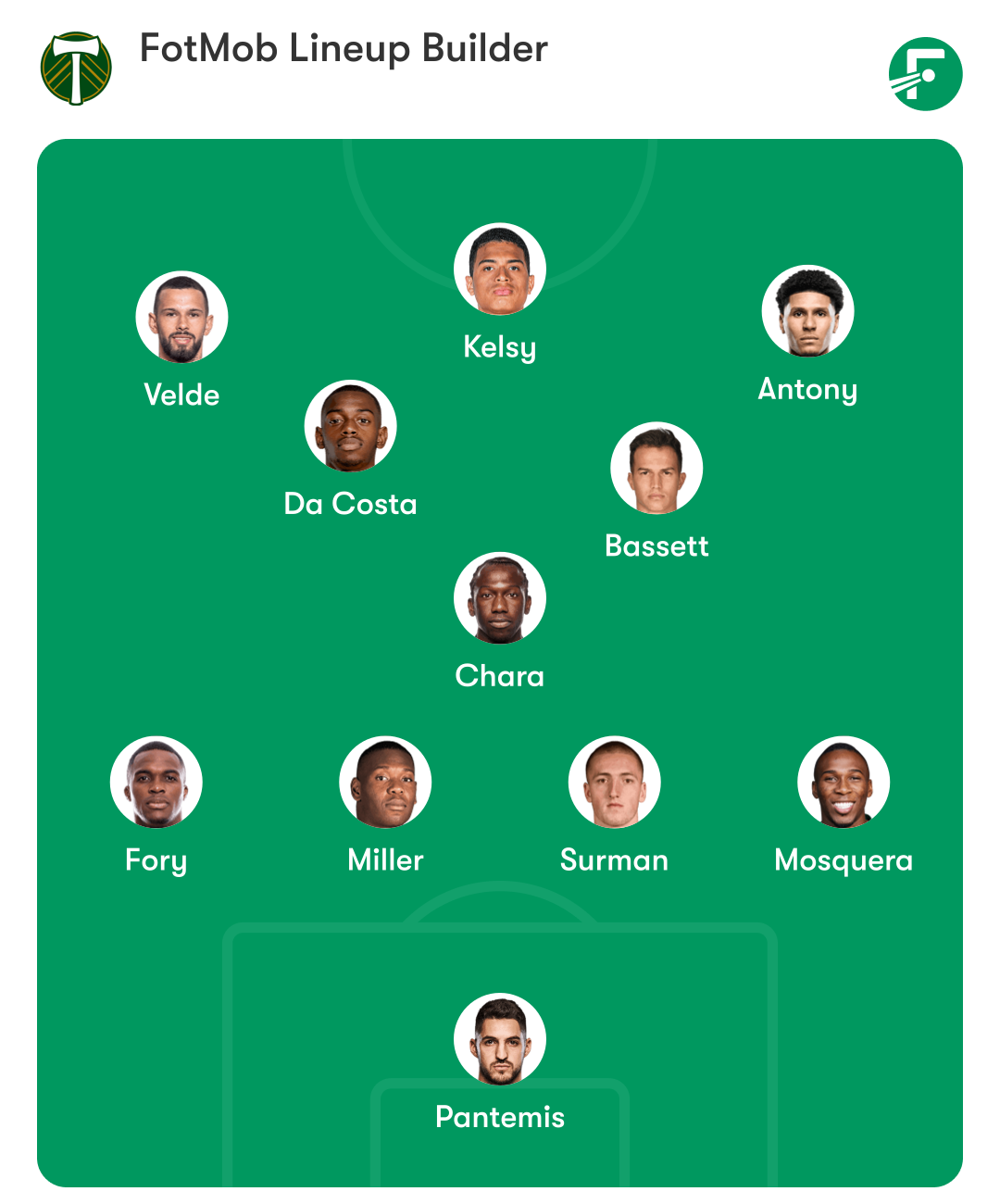
Based on two seasons of Neville-ball in Portland, we can also draw some fairly confident conclusions about how he wants the above XI to play. In general, Neville believes in getting his best players the ball as often as possible. That usually means Designated Player attackers, and those who can influence the game and tilt the direction of the field in favor of the Timbers.
Specifically, this is going to mean four main players in 2026 (at least early on): Kristoffer Velde, David Da Costa (once healthy), Antony, and Cole Bassett. Those are the guys that Phil wants to get the most touches, and wants to "grab the game by the scruff of the neck" – an oft-repeated axiom used by Neville.
That axiom actually describes a lot of his tactical style and ethos. It's all kind of a "give the man the rock and let him cook" approach, wherein Neville expects his biggest players to be the ones winning games.
Now, if that all sounds more "Ba-ba-ba-ba-ba-basketball" and less "Open wide for some soccer" then, uh, yeah you're right. And you're catching on to what is probably the biggest weakness of Neville's tactics as a coach: he doesn't really have a set philosophy or defined patterns of play.
To be clear: that isn't necessarily a deal-breaker. Plenty of successful coaches have loose ideals that flex based on matchup and roster construction. I would argue that last year's MLS Cup winner, Javier Mascherano, is more akin to "loose ideas & vibes" than "rigid ideologue", for example.
But when we get into the nitty-gritty of how the Timbers will presumably attack and defend in 2026, it may start to become a weakness. Particularly in the final and defensive thirds – the most important thirds of the soccer pitch.
All of that is indeed speculative, though. So let's move away from what we know, and into...
What I think I know (I think)
This is where I lean on ASA's preview and build off of what their data suggests (again – hope you did your homework!).
The main thrust, as suggested by the title of this article, is that three of Portland's most important players love to dribble. The underlying numbers suggest that Da Costa, Velde, and Bassett all are more inclined to dribble forward in the attack first, rather than look to pass first.
Combining this with the data compiled by Futi, who is doing the lord's work now that FBref is a shell of its former self, we can get a clearer picture of how the Timbers are likely to attack (and by result defend).
According to their MLS data table, based off of previous seasons the Timbers are a "Control and Regroup" style team, who values patient progression and compact defense. Essentially, they more often than not look to maintain possession and defend with numbers.
We're not gonna go too deep into that description here, but combine that analysis with the propensity to dribble and you can form a decent prediction of how Portland might look this year.
This could have a myriad of impacts on the Timbers on the field this year. Let's run through them, starting with the positives.
Dribbly Boys! (Laudatory)
The propensity to dribble is an asset that the Timbers haven't really enjoyed the benefits off since Santiago Moreno peaced out midway through 2025. Carrying the ball out of the midfield would help collapse defenses and make more room on the wings, so some combination of Bassett & Da Costa driving forward and then laying the ball off for Velde, Antony, or one of Kevin Kelsy or Felipe Mora may very well be a sustainable way for Portland to find their way into the final third.
The reverse could be true for Velde as well. Hard running in from the wing, especially in transition, could end up in opposing fullbacks getting put on ice skates and Velde blowing past them. Then, Portland's newest DP would have the chance to shoot or find one of the late-arriving midfielders in the box.
This would align well with Neville's philosophy of attack as well. "Getting the ball to the best players" means that Bassett, Da Costa, and Velde will presumably have a lot of chances to do what they want to do: dribble.
Hence, the theme for 2026: "Phil Neville & the Dribbly Boys".
On a macro level, having players whose instinct is to dribble and run might benefit Portland into breaking out and taking higher quality shots. Remember how Portland was a "Control and Regroup" team who prioritized possession last year? Well in reality it looked more "regroup" than "control", and the possession was more ponderous than purposeful.
A great anathema to that is players who aren't afraid to do something with that possession. It could be through passing patterns, but as established that's not really Neville or the Timbers' modus operandi. So, doing it with direct attacking with the ball is the next best thing.
If you consider that the thing your best players are the most comfortable and familiar with is something that directly maximizes your game model, you can see the path forward for the Timbers.
But, you can also probably see the drawbacks of the Dribbly Boys. Which brings us to...
Dribbly Boys... (Derogatory)
The obvious drawback that having too many Dribbly Boys is that, well, you have too many boys who want to dribble.
And specifically, not enough guys who want to pass (Passy Boys? We'll workshop it).
Velde, for all of his offensive determination and spunk, did not showcase a ton of high-level passing ability last season. And whether it was through his shoulder injury or on-field fit concerns, neither did Da Costa. Bassett didn't make his name in Colorado by being a top-tier passer, and was best known as a tertiary crasher of the box.
None of those players, who are likely to get the most of the ball this season, can therefore call pinpoint passing one of their strengths. Sure, they of course can pass. But it's not necessarily something that they do comparatively better than other on the field.
So the question of "Who's gonna hit the killer final ball?" is an open one for the Timbers. And based on the significant lack of quality service Portland suffered from last year, it is a question that could loom large over the offense.
It's compounded by the aforementioned lack of a specific tactical style. I would guess that the plan in the final third is more "make stuff happen" and less "do this, look for this, and try to do this". That is to say, Portland might do a good job of getting into the final third, but not a ton of ideas about what specifically to do once they get there.
But the most obvious drawback of having too many dribbling midfielders is what it does to the remainder of the midfield, and Portland's defensive shape. If you noticed in the projected lineup from above, Portland will likely be shifting to having two offensively oriented midfielders, rather than the two defensively oriented ones they had in 2025. That is going to put a ton of pressure on the lone defensive midfielder to shield the backline.
And, as of time of publishing, that lone defensive midfielder is very likely to be the soon-to-be 40 Diego Chara. He is an absolute legend, and give him enough time and training and he could probably do anything on a soccer field. But man that is a ton to put on the shoulders of a man who hasn't lost a step, but perhaps isn't the most consistent in the twilight of his career.
Plus, it's not like Portland's midfield was lights out even with two defensively minded midfielders last season. All too often Portland gave up goals by being beat right up the gut, as there were a lot of gaps in front of their backline. With Bassett and Da Costa likely to drive forward, I do not think it is likely that those gaps are going to decrease.
Where that leaves Portland is a) asking a ton of a lone defensive midfielder, b) asking Bassett or other options to do a lot more tracking back and minimizing their attacking influence, c) demanding the backline and in particular the centerbacks be ready to live on a knife's edge and defend a ton in space, or d) all of the above.
That is a lot of big asks, and some huge consequences if they can't be met. So the output of the Dribbly Boys could very well be a super-aggressive offense with not a ton of tactical structure, and a super-threadbare defense with not a ton of tactical structure.
Gulp.
What we don't know
Speed round:
- Who in the heck is going to win the starting striker job? You might have noticed that I have not talked about the strikers much in this preview, and that's because to the best that I can tell their primary (maybe only?) job in Neville's system is "put ball in net, make score go up". So, who's gonna be that guy? It's a wide open race between Kelsy, Pipe, and Gage Guerra. All three have different styles of play. Who wins, and how does that impact the squad?
- How do the wingers factor in? Outside of Velde, Portland's wingers leave a lot to be desired. Antony is inconsistent, and neither Ariel Lassiter or Omir Fernandez bring a lot to the table. Might the arrival of a new winger add a needed dimension to Portland's attack?
- Will the double-pivot return? As mentioned, it sure feels like Portland is trending towards a single-pivot in the midfield. If (when?) the midfield gets overrun on a continuous basis, could that spur Neville to change his midfield lineup? What knock-on effects could that have on the squad?
- Is there an x-factor of passing out of the back? Alex Bonetig has fashioned himself as a centerback who likes to play with the ball, and who prides himself on his passing. How much could line-breaking passes out of the defense be an asset for the Timbers this year?
- Are set pieces fixed fixed now? We saw Portland improve defensively at set piece, but take a giant step back offensively in 2025. Will they finally be better on both side of the ball in 2026?
How is it all going to work?
Overall, like all other things about the Timbers, we are squarely in "wait and see mode". As outlined, you can see the path forward for Portland's tactical plan to maybe work. Perhaps the abundance of Dribbly Boys could unlock Portland's attack with an excess of overwhelming directness, and Diego Chara can perform one more superhero season. And maybe the defense takes another step or two forward and gets better at defending in space.
But that is a whole lot of qualifiers. Just as likely is the Dribbly Boys all trip over each other (Trippy Boys? We'll workshop it), nobody is able to deliver consistent service, and Portland proves that three do not go into one. And that would therefore leave an impossible number of gaps in Portland's midfield for opposing attackers to maliciously take advantage of, and Portland's solidly mediocre remains just solidly mediocre.
Personally, I am going to reserve most of my judgment on which way it will fall for at least the first third of the season. I choose to be an optimist – at least until the world throws it back in my face.
But with each poor performance, and every match where the weaknesses I've outlined get exposed... the optimism can only go so far.
And with that existential fear now sparked in our hearts, it brings us to maybe the biggest part of this three-part season preview: The Stakes. Coming Friday.


